
Install the app
How to install the app on iOS
Follow along with the video below to see how to install our site as a web app on your home screen.

Note: This feature currently requires accessing the site using the built-in Safari browser.
-
Thank You For Visiting... Please Click Here and sign up to contribute and reply to posts and download the resources.
You are using an out of date browser. It may not display this or other websites correctly.
You should upgrade or use an alternative browser.
You should upgrade or use an alternative browser.
Corn Millers - Rawtenstall
- Thread starter moggi1964
- Start date

- Joined
- Mar 11, 2021
- Messages
- 84
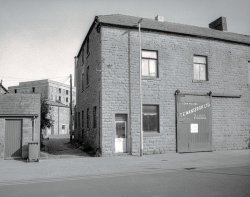
Beautiful photograph, again I'm particularly drawn to images of industrial subjects. I like the high values on the white-painted door and the very open shadows in the alley-way. And personally I like seeing what goes on in structures like this, here it's "corn milling".
Guessing it's the bottom you cropped. I don't think you lost anything and may have even improved the image.
What focal length lens were you using? On my Linhof Master Technika 3000 the bed doesn't start to intrude until I use a 100 mm lens and then it's only a problem when the back is rotated to the vertical/portrait position.
David
Guessing it's the bottom you cropped. I don't think you lost anything and may have even improved the image.
What focal length lens were you using? On my Linhof Master Technika 3000 the bed doesn't start to intrude until I use a 100 mm lens and then it's only a problem when the back is rotated to the vertical/portrait position.
David
- Joined
- Aug 29, 2020
- Messages
- 1,368
Like @David Lindquist I am drawn to industrial subjects, in my case, ones exhibiting decay and disuse (which this isn't I don't think).
And ... like @Ian Grant said, we've all been there. Oddly, my mishap was with a 65mm f/8 Super Angulon as well, if memory serves.
Noting that moving across this digital medium incurs all manner of potential issues with loss of fidelity due to transmission problems, I do have a couple of small observations about the image, at least as seen here on my monitor:
And ... like @Ian Grant said, we've all been there. Oddly, my mishap was with a 65mm f/8 Super Angulon as well, if memory serves.
Noting that moving across this digital medium incurs all manner of potential issues with loss of fidelity due to transmission problems, I do have a couple of small observations about the image, at least as seen here on my monitor:
- I don't know whether this is a scanning artefact or the developer, but the image seems unusually grainy for Fomapan 100. It's not excessively so, just more grainy than I expect. Of late, I've been doing a lot of fiddling with it in 12x9 format and have not noted that much grain, even when developed in a fairly high acutance developer (D-23 1:9).
- For my taste (and that's all it is), the image would benefit somewhat from a slight increase in local contrast. I split VC print on silver paper, so please understand my comment is heavily biased by that, but I'd love to see the front face of the building with a bit more black in it, the alley just a bit less black and highlights overall brought up very slightly. I'd likely bring down the foreground street a bit so as to reduce the looming block of grey in the foreground. Again, this is my taste and not some law of photography

Last edited:
- Joined
- Aug 9, 2016
- Messages
- 854
I agree. The sky looks very grainy. And the tones look very flat for a photograph taken in full sun. This isn't a criticism. It just seems that something went wrong somewhere along the line.
The relatively low contrast of the wall is caused by the angle of the sunlight, not by development. If it had been taken a little earlier, the light would have just grazed the surface, revealing a great deal more of the inherent roughness. It might have been interesting to make a series of exposures as the sun progressed around.
- Joined
- Aug 29, 2020
- Messages
- 1,368
The relatively low contrast of the wall is caused by the angle of the sunlight, not by development. If it had been taken a little earlier, the light would have just grazed the surface, revealing a great deal more of the inherent roughness. It might have been interesting to make a series of exposures as the sun progressed around.
Normally, I'd agree. What makes me a tad suspicious is the unusually high level of grain, very clearly seen in the sky. Unless this is a scanning/postprocessing artefact, with a fine grained film like this, it's most usually associated with development issues.
I just happened to have been using a lot of Fomapan 100 in 12x9 sheets in the past few weeks and none of the negatives I produced with either DK-50 or D-23 in any of the dilutions had anywhere near that grain, hence it caught my eye.
- Joined
- Aug 29, 2020
- Messages
- 1,368
Yes indeed. The grain is more like 35mm Tri-X, perhaps in Rodinal Curious. I’ve never seen micro reticulation. Can this be it?
Even Tri-X can be made to exhibit far less grain. I've pointed to this example in other threads but ... here is handheld 35mm Tri-X in Pcat 1.5:1:300 EMA for an hour:
https://www.tundraware.com/Photogra...ver/media/large/20220906-1-14-Lock-N-Rock.jpg
So, it could be any number of things and I wouldn't hazard a guess, really. I only ever even mentioned this so that the OP could look into their developing practice for possible gremlins. I've not used DD-X but Fomapan in both DK-50 and D-23 even if I dilute them for highest possible acutance does not show that kind of grain.
Possible gremlins that come to mind:
- Temperature induced reticulation
- Improper developer dilution
- Over agitating
- Wildly high developer temperature
- Tainted water or containers
- The phase of the moon
@moggi1964 please do not read this as me being meanspirited. Just trying to help ... we've all been there at one point or another.

- Joined
- Dec 5, 2021
- Messages
- 249
Thank you everyone for the mind words and constructive feedback. I appreciate both immensely but especially the latter.
The lens was a 90mm SK Angulon F/6.8 so I just need to drop the bed a small amount and it will be out of frame. The building is a working millers and feed seller, been around for 100 years or so in the area.
My own thought is it is a developing issue and a post processing issue and if I share something I saw in another image I took that might contribute to the explanation.
The shot above was taken about 30 minutes after the cricket shot below but with the sun behind me rather than to the left of frame. When I scanned the cricket image and zoomed in, one of the white shirts was like chunks of white rather than smooth pieces of white. It was a very bright day and it may be that's just how things look at large magnification. See below:
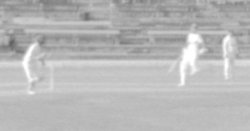 This was one of my first tries at stand development using Ilford DD_X in a 1:9 solution.
The negative was soaked in 20c water for 5 minutes then drained. Then 1 minute of agitation in the dev followed by 40 minutes stand. Stop and Fix using Ilford then wash. All done at 20C.
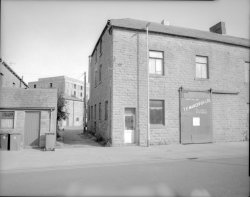
I scanned it 'flat' on an Epson 3200 then played around with it in Luminar, tweaking contrast, black and white point and cropping of course. Here is the flat scan.
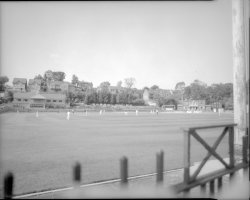
Here is a flat scan of the cricket:
Please continue to share your thoughts and advice; I AM HERE TO LEARN.
The lens was a 90mm SK Angulon F/6.8 so I just need to drop the bed a small amount and it will be out of frame. The building is a working millers and feed seller, been around for 100 years or so in the area.
My own thought is it is a developing issue and a post processing issue and if I share something I saw in another image I took that might contribute to the explanation.
The shot above was taken about 30 minutes after the cricket shot below but with the sun behind me rather than to the left of frame. When I scanned the cricket image and zoomed in, one of the white shirts was like chunks of white rather than smooth pieces of white. It was a very bright day and it may be that's just how things look at large magnification. See below:
This was one of my first tries at stand development using Ilford DD_X in a 1:9 solution. The negative was soaked in 20c water for 5 minutes then drained. Then 1 minute of agitation in the dev followed by 40 minutes stand. Stop and Fix using Ilford then wash. All done at 20C.
I scanned it 'flat' on an Epson 3200 then played around with it in Luminar, tweaking contrast, black and white point and cropping of course. Here is the flat scan.
Here is a flat scan of the cricket:
Please continue to share your thoughts and advice; I AM HERE TO LEARN.
- Joined
- Dec 5, 2021
- Messages
- 249
I could have done so I'll go back and have another go and see how it turns out making sure nothing is adding sharpening. I know when I export to JPG there is a small amount of sharpening added but that should show in the flat scans too so it likely isn't that.Did you apply any sharpening? Some settings can exaggerate grain.
Thanks David.
- Joined
- Aug 29, 2020
- Messages
- 1,368
I have no explanation for the apparent grain, but after reading you latest, some thoughts occur...
The very bright whites are a consequence of shooting into a high SBR (Subject Brightness Range - the range of useful light from brightest to darkest). Normally, we expose for the shadows and develop for the highlights. But with stand development, you are developing the shadows (via long duration in developer) and using developer exhaustion to control the highlights (via developer dilution and infrequent agitation).
It's critical to make sure you're not overexposing. You can put your highlights so far up the exposure curve that they won't hold detail when you make the exposure no matter how you develop them.
So ... if you are losing detail in the highlights - assuming this is not a limitation of the scanner and software - you can try one of the following things:
Other, more fiddly options:
The very bright whites are a consequence of shooting into a high SBR (Subject Brightness Range - the range of useful light from brightest to darkest). Normally, we expose for the shadows and develop for the highlights. But with stand development, you are developing the shadows (via long duration in developer) and using developer exhaustion to control the highlights (via developer dilution and infrequent agitation).
It's critical to make sure you're not overexposing. You can put your highlights so far up the exposure curve that they won't hold detail when you make the exposure no matter how you develop them.
So ... if you are losing detail in the highlights - assuming this is not a limitation of the scanner and software - you can try one of the following things:
- Agitate less frequently - but you can't because you are doing true stand (which I do not recommend because it's prone to bromide drag).
- Increase the dilution of the developer and increase development time - say to 60 min. This will still develop the shadows to completion (because of the longer time). But highlight development will stop sooner (because of there being less developer in solution). This may not work for all developers and I've not idea what DD-X will do with that.
- Switch to a developer that has "compensation" effect that tend to keep the highlights calmed down. Both D-23 and Pyrocat-HD in a variety of dilutions will give you that.
Other, more fiddly options:
- The Nuclear Option: Use "split" development with a two part developer like D-23 or Pyrocat-HD. You first develop the negative for a while in the Part A solution, and then separately in the Part B solution. This is a very error prone process to get right but it gives you very effective control of highlight development.
- There are also other techniques for this involving water baths which St. Ansel himself documents.
- Joined
- Aug 9, 2016
- Messages
- 854
Moggi, can you tell us why you opted for stand development?
- Joined
- Dec 5, 2021
- Messages
- 249
Well it turns out I was using Fomapan 200 not 100 (I knew I had 100 but it turns out that is for the half plate). So I definitely overexposed
As for the choice of stand development, honestly I was just trying something different to see how it worked.
As for the choice of stand development, honestly I was just trying something different to see how it worked.
- Joined
- Aug 29, 2020
- Messages
- 1,368
Well it turns out I was using Fomapan 200 not 100 (I knew I had 100 but it turns out that is for the half plate). So I definitely overexposed
As for the choice of stand development, honestly I was just trying something different to see how it worked.
So I am quite fond of (semi)stand and EMA as advanced development techniques. I even wrote up my findings in some detail (see link below). HOWEVER, I would recommend against using them until/unless you have a strong mastery of a using a single developer with a few (1 or 2) films using conventional agitation and you have mastery of exposure control and placement.
The high dilution/low agitation techniques are powerful tools in one's quiver but they rapidly implode if you don't have flawless exposure management and darkroom technique. Even after 50 years in the darkroom and 3+ doing low agitation development, I still routine crater a few negatives here and there because I got sloppy about exposure management. Here's an example of what happens when you do not expose properly for the shadows doing semistand:
I my defense, I was testing DK-50 at higher than recommended dilutions and wasn't all that worried about a "good" image, but it's still illustrative.
My notes on low agitation development can be found here:
tundra/Stand-Development
 gitbucket.tundraware.com
- Joined
- Aug 29, 2020
- Messages
- 1,368
So much to learn. Thank you.
There always will be
But standing development isn't the best place to start On my screen, the building doesn’t look over-exposed. The shadow detail looks fine. Would you have otherwise exposed at box speed? Zone System lore suggests exposing at about half box speed, so you might have inadvertently been following in Saint Ansel’s footsteps.
The white door seems fine for exposure, but it doesn’t have the grain. That remains a mystery.
I second the advice to follow a more conventional path in development, until you have evolved a reliable procedure. Almost all of the images we admire were produced this way.
The white door seems fine for exposure, but it doesn’t have the grain. That remains a mystery.
I second the advice to follow a more conventional path in development, until you have evolved a reliable procedure. Almost all of the images we admire were produced this way.