There is no other subsequent focus adjustment
That seems to be right.
Again I understand your camera working with the Sinar principle.
All depends on angles, and the physic of optik is based on math.
Mr. Koch, the Sinar founder, has been a Master of math.
Mr. Schön is very fine with angles, too; he also gave an instruction for this angle things around an analogue disc player.
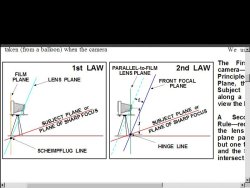
Both are using the principle of Scheimpflug also being a math based thesis describing the physical optic.
With math or optical physic you can do things from both sides.
Instead of tilting your lens(-standard) you are tilting the rear standard.
This praxis is not exclusively for your camera or Sinar cameras, but the lines given on the GG make things more easy.
I don't know your camera nor the manual.
All I can say is that Sinar clearly describes bringing the angle from the rear to the front, and don't forget to zero positioning the rear.
Me I have learned this technique being helpful with large cameras, because it saves some kilometers walking to the
front standard doing some movements, walking back to the GG for a check and so on

Feel free to try out your technique with close ups - you will fail.
This will make eggs out of circles like clocks.
Ok, short lenses and short distances will egging circles, too so better take a long lens.
The rear standard is the tool for controlling perspective, and in my understanding you are voluntary giving up the best perspective.
I also can't imagine following a tilted rear standard-near/far-point principle when photographing buildings.
There I personally have to deside which rear standard angle will bring the required perspective.
There are those who said we have to adjust the DOF by measuring the difference between near and far focal points
Your real question has been around the determination of an fstop, right.
Probably a low fstop, if typically setting f22 wouldn't match the task.
But, we don't HAVE to adjust the DOF with bellow's difference.
Me I feel free to use different tools or techniques, and I feel free to design my picture with unsharpness and low fstops.
Again the GG is the required tool then.
I have no idea about your camera but would always bring the rear angle to the front.
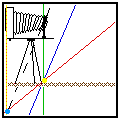
Now seeing the near and far point by moving the bellows with the focus knob will give you a linear bed movement which could be read if a millimeter scale was placed to the bed.
You also could read the circular route of the focusing knob if a scale has been placed.
I have no other idea yet, sorry.