Focus scales for Chamonix O45 F-2

But how do you do both tilt and
Center focus (at the same time)?
After you've applied all of the adjustments for tilt, are you supposed to then find the far and near focus points and center the knob? That takes the whole tilt process and throws it away
Did I miss the answer to my question?
 
We may be underestimating the importance of skill. In fact, we haven’t mentioned it at all. Whatever may be said of photography as a (cap-A) Artform, it’s undoubtedly a craft. Technology has made it possible to produce perfectly adequate photographs with no craft ability at all, but Large Format (and perhaps film in general) demands some personal input.
Just how much we rely on personal skills and how much on defined procedures is a personal matter. There’s no escape from using a mixture of both, I suggest
An interesting point is raised by Reginald S on the aesthetic choice of f4. It’s probably true that most LF workers are aiming for the maximum sharpness over the maximum part of the image, but it’s not the only consideration.
 
But how do you do both tilt and Center focus?
After you've applied all of the adjustments for tilt, are you supposed to then find the far and near focus points and center the knob? That takes the whole tilt process and throws it away
Did I miss the answer to my question?
[/QUOTE]

Please let me ask how do You work with your camera to find tilt angle and focus ?

It’s probably true that most LF workers are aiming for the maximum sharpness over the maximum part of the image,

Once LF has been the synonym for sharpness, yes.
But over the last 15 years I have seen many people following the more and more expensive hype of grabbing ancient specialists like Petzvals, P&S lenses and this.
Imagons and friends for less money, experiments with simple lenses, and don't forgot the lensless cameras.
Have seen them stepping into pictorialist's footprints, threads called "The Jim Galli Thread" rised up..

This are f4 guys and ladies, and this is me, too.
I believe that we are also doing f22, or f64 with ULF, and all the Scheimpflug manouvres - but we also felt in love with using the aperture again.
And, concerning min. depth of focus, ULF with open lenses is a theme; using Scheimpflug with LF /ULF is a great thing while widely open the lens.
To me especially with head-shoulder portraits .
This techniqes aren't modern ones but was daily practice for prof. photographers.
Some of these mostly unsharp pictures have been the reason for buying my first LF camera (13x18cm) decades ago :)
 
Did I miss the answer to my question?

Please let me ask how do You work with your camera to find tilt angle and focus ?


Once LF has been the synonym for sharpness, yes.
But over the last 15 years I have seen many people following the more and more expensive hype of grabbing ancient specialists like Petzvals, P&S lenses and this.
Imagons and friends for less money, experiments with simple lenses, and don't forgot the lensless cameras.
Have seen them stepping into pictorialist's footprints, threads called "The Jim Galli Thread" rised up..

This are f4 guys and ladies, and this is me, too.
I believe that we are also doing f22, or f64 with ULF, and all the Scheimpflug manouvres - but we also felt in love with using the aperture again.
And, concerning min. depth of focus, ULF with open lenses is a theme; using Scheimpflug with LF /ULF is a great thing while widely open the lens.
To me especially with head-shoulder portraits .
This techniqes aren't modern ones but was daily practice for prof. photographers.
Some of these mostly unsharp pictures have been the reason for buying my first LF camera (13x18cm) decades ago :)
[/QUOTE]
I shoot landscape pictures so look for deep depth of field. If I'm using tilt, my camera can be set up asymmetrically tilted. I then set the aperture for F-22 or maybe at f 32 if I think I need a bigger depth of field. If the picture doesn't lend itself to tilt, then I just calculate the F stop based upon the depth of field chart I keep for each of my lenses.

But I don't use that centimeter knob procedure to calculate depth of field and if I did how would I combine that with tilting at the same time?
 
Thanks, Alan.
I have thought that I answered your question before but I haven't seen the point.
You probably mean "reading" the centimeter knob instead of simply "turning" the knob, yes?

With my Shen Hao I once let my hands simultanely do their job while regarding the results on the GG.
Turning the bellows knob without a centimeter scale there by the right hand, tilt ands swing with the left.
Without a Chamelon's technique , to me, too it seems to be unpossible regarding GG and centimeter scale in one action.
But is it necessary?
I don't think so.
At least if the lens is already tilted with meeting the Scheimpflug conditions.
 
Thanks, Alan.
I have thought that I answered your question before but I haven't seen the point.
You probably mean "reading" the centimeter knob instead of simply "turning" the knob, yes?

With my Shen Hao I once let my hands simultanely do their job while regarding the results on the GG.
Turning the bellows knob without a centimeter scale there by the right hand, tilt ands swing with the left.
Without a Chamelon's technique , to me, too it seems to be unpossible regarding GG and centimeter scale in one action.
But is it necessary?
I don't think so.
At least if the lens is already tilted with meeting the Scheimpflug conditions.
The way my Chamonix 45H-1 with asymmetrical tilt works is as follows: I focus using the front or rear focusing knob that moves the standard(s) extending or contracting the bellows lining up the lower axis (distant) focus point. The axis for this camera is about 1/4 the way from the bottom. Then you tilt the rear standard backwards until the near subject point is in focus. That's it. The camera stays focused on the far point. You never really have to refocus after then. So you never measure the cm distance between far and near focus points. So how would you then determine the f stop using the cm measuring method?
 
Your focusing principle seems to be based on the sinar system: Connecting the spots near/ far via the plane of sharp focus.
But I believe that you also have to transfer the rear standard' angle to the frontstandard and then bringing back the rear standard to a right angle?
Otherwise you are manipulating the perspective.
By the way, Mr. Schoen is describing the disadvantage of tilting/retilting the back standard technique in his scripts, but mostly it seems to work.

So you never measure the cm distance between far and near focus points. So how would you then determine the f stop using the cm measuring method?

As said before tilting is not only a tool gaining great depth in the field.
It's a very important tool for using best possible open apertures.
Often, more light or faster shooting are important reasons to us.
Since we have no DOF markings on our lenses the bellows difference from near subject to far subject becomes our tool.
Sinar with it's asymmetrical axis standards has no problem turning a knob with a scale.
You either can read circulary scales on knobs or the linear scales on the camera rail or -bed.
The bellows difference leads to the min. aperture required.
If no scales are given we can have a look onto Linhof's aperture tale referring to bellows difference.

Alan, I don't know anything about your skills but in general we could say that many people have great misunderstandings in what will happen while "focusing" after tilt.
The same to what is a near and a far point, depending on the action "focusing the focus plane" and using the bellows difference.

We could have a look at Mr. Scheimpflug or Merklinger first, and then to Mr. Schoen.

Scheimpflug:

Hinge Scheim Skizzen.JPG

Merklinger(click on the graphic):
MicroMov.gif
 
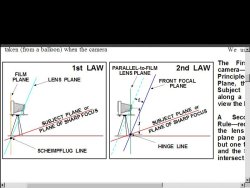
After tilting the lens to the correct angle dependig on FL and camera stand the focal plane (plane of sharp focus) falls in place.
This means the focus from near subject to far subject is given - along the small focal plane.

If we imagine the focal plane being parallel to the film plane ( as given with fix standard cameras) we understand what we have done (focusing the focal plane) , and what is missing - the depth of field.

Mr. Merklinger's movie is showing what happens if using the focusing knob after tilting the lens (to the right angle).
Moving this knob now has nothing to do with focusing to a point or to a better DOF - it will shift the position of the focal plane instead.

But since the socalled near and the far point ar on top and on the bottom now, what a dilemma, instead of being near and far, we can use them for determining the difference of the bellows movement.

This is known from diverse scripts like Sinar, or Linhof / Mr. Schoen:
Sorry from reason of copyright I will present only a link.


Please click https://www.weschoen.de/Scheimpflugwinkel finden A4.pdf for further informations.
There's a graphic showing some points (Nahpunkt / Fernpunkt).
 
After tilting the lens to the correct angle dependig on FL and camera stand the focal plane (plane of sharp focus) falls in place.
This means the focus from near subject to far subject is given - along the small focal plane.

If we imagine the focal plane being parallel to the film plane ( as given with fix standard cameras) we understand what we have done (focusing the focal plane) , and what is missing - the depth of field.

Mr. Merklinger's movie is showing what happens if using the focusing knob after tilting the lens (to the right angle).
Moving this knob now has nothing to do with focusing to a point or to a better DOF - it will shift the position of the focal plane instead.

But since the socalled near and the far point ar on top and on the bottom now, what a dilemma, instead of being near and far, we can use them for determining the difference of the bellows movement.

This is known from diverse scripts like Sinar, or Linhof / Mr. Schoen:
Sorry from reason of copyright I will present only a link.


Please click https://www.weschoen.de/Scheimpflugwinkel finden A4.pdf for further informations.
There's a graphic showing some points (Nahpunkt / Fernpunkt).
The linked chart indicates that f8 is enough with tilts for DOF and you need f/16 probably f/22 if using no tilts. Those pictures especially the second one opens a different view of DOF with tilts than I conceptualized before and was helpful.
Scheimpflugwinkel finden A4 d+e.indd (weschoen.de)

But I still don't how that would apply with my Chamonix with asymmetrical rear tilting. You only focus with the bellows once: when you set the far focal point on the bottom axis line which is about 1/3 the way from the bottom in line with the standard axis. Then you only have to tilt the rear standard back to get the near in focus and you're done. (Yes, there will be so change in perspective, but the asymmetrical tilting work on the rear standard only with my Chamonix. )There is no other subsequent focus adjustment and you have made no determination of how far in cm the far is the front focus point. So what do I do about that?
 
Are we inadertantly conflating these two different functions? Depth of Field is something that all lenses exhibit. Moving the angle of the plane of focus is something that only view cameras have. (...yes I know about tilt/shift lenses for smaller formats). They can be utilised independently.
I have to assume that we all know about the relationship between DoF and aperture. Tilting is another matter, as not all scenes have conveniently distributed subject matter. We have to make the best job of it that we can.
A typical diagram explaining tilt will have a boulder in the foreground and a pine tree in the background, and we can conveniently tilt the front, (or the back if we are happy with the geometric changes) while examining the GG until everything looks fine. But what if the pine tree is in front and the boulder behind? Then we have to use cunning and experience to get the best possible result from the material available to us. We have to juggle with both techniques to find the best possible compromise.
I don't think there is a royal road to perfect sharpness. The Universe is cleverer than that and often very capricious. As we all know, just when we've got the image sharp, the sun goes in.
 
Are we inadertantly conflating these two different functions? Depth of Field is something that all lenses exhibit. Moving the angle of the plane of focus is something that only view cameras have. (...yes I know about tilt/shift lenses for smaller formats). They can be utilised independently.
I have to assume that we all know about the relationship between DoF and aperture. Tilting is another matter, as not all scenes have conveniently distributed subject matter. We have to make the best job of it that we can.
A typical diagram explaining tilt will have a boulder in the foreground and a pine tree in the background, and we can conveniently tilt the front, (or the back if we are happy with the geometric changes) while examining the GG until everything looks fine. But what if the pine tree is in front and the boulder behind? Then we have to use cunning and experience to get the best possible result from the material available to us. We have to juggle with both techniques to find the best possible compromise.
I don't think there is a royal road to perfect sharpness. The Universe is cleverer than that and often very capricious. As we all know, just when we've got the image sharp, the sun goes in.
Did I miss something earlier said. There are those who said we have to adjust the DOF by measuring the difference between near and far focal points and centering the focus after doing tilts. Was I wrong?
 
Yes. DoF is determined by aperture. The far-and-near focus point procedure determines where it falls.
 
There is no other subsequent focus adjustment

That seems to be right.
Again I understand your camera working with the Sinar principle.

All depends on angles, and the physic of optik is based on math.
Mr. Koch, the Sinar founder, has been a Master of math.
Mr. Schön is very fine with angles, too; he also gave an instruction for this angle things around an analogue disc player.
Both are using the principle of Scheimpflug also being a math based thesis describing the physical optic.

With math or optical physic you can do things from both sides.
Instead of tilting your lens(-standard) you are tilting the rear standard.
This praxis is not exclusively for your camera or Sinar cameras, but the lines given on the GG make things more easy.

I don't know your camera nor the manual.
All I can say is that Sinar clearly describes bringing the angle from the rear to the front, and don't forget to zero positioning the rear.
Me I have learned this technique being helpful with large cameras, because it saves some kilometers walking to the
front standard doing some movements, walking back to the GG for a check and so on :)

Feel free to try out your technique with close ups - you will fail.
This will make eggs out of circles like clocks.
Ok, short lenses and short distances will egging circles, too so better take a long lens.

The rear standard is the tool for controlling perspective, and in my understanding you are voluntary giving up the best perspective.
I also can't imagine following a tilted rear standard-near/far-point principle when photographing buildings.
There I personally have to deside which rear standard angle will bring the required perspective.


There are those who said we have to adjust the DOF by measuring the difference between near and far focal points


Your real question has been around the determination of an fstop, right.
Probably a low fstop, if typically setting f22 wouldn't match the task.

But, we don't HAVE to adjust the DOF with bellow's difference.
Me I feel free to use different tools or techniques, and I feel free to design my picture with unsharpness and low fstops.
Again the GG is the required tool then.

I have no idea about your camera but would always bring the rear angle to the front.
Now seeing the near and far point by moving the bellows with the focus knob will give you a linear bed movement which could be read if a millimeter scale was placed to the bed.
You also could read the circular route of the focusing knob if a scale has been placed.

I have no other idea yet, sorry.
 
Last edited:
Back
Top