Longstanding Test With D-23

thronobulax

Very Active Poster
Registered User
Joined
Aug 29, 2020
Messages
1,394
First a bit of backstory (I've mentioned this before in other threads). Many years ago, the local camera shop also served as the place you went to have your film developed and printed. I am told that it was the practice of at least some of these to hang the film in a tank of D-23, agitate it a bit, do so again at closing time, and let it sit there overnight. This effectively was a very long form of Semistand processing. My guess- and that's all it is - is that they did this because doing so would give them shadow development to completion and protect the highlights without having to worry too much about temperature or type of film. Keep in mind, this was done in large volume for their consumer customers, long before automated development machines came along.

Since the internet is full of people who are all "experts", I learned long ago the only way to validate these kinds of claims was to ... you know ... go try them myself. I've also wanted to try out D-23 at higher dilutions than 1:1 to see what happens when you really cut down on the solvent effect of the developer.

Last night, I mixed up a fresh batch of D-23 1:1 to replenish my working bottle. (See P.S. below.)

Well, that left me with a litre or so of old D-23 1:1. "So," sez me, "Let's do a two variabled experiment. I'll further dilute the developer to 1:3 and do the overnight thing." And that's just what I did.

I shot a couple of sheets of Fomapan 200 5x4 at full box ASA, prewet them for 3 min, agitated continuously for 2 min in D-23 1:3, and let them sit for a couple of hours. Then I gave them 30 seconds of further agitation time. This morning I pulled them out for stop/fix/wash. Total development time was 16 hours.

I have no scans to share just yet, but I have a few observations:

  1. Looking through the negs, they look very clean. No sign of bromide drag or other nasty artefacts.
  2. The negs DO look different though. The negative seems somewhat more dense than what I see with 60min Semistand. Looking through the neg appears normal, however. The emulsion seems much more obviously matte surfaced than a normally developed Fomapan 200 neg does.
  3. Interestingly. the unexposed borders of the negative look like they are slightly fogged, but upon closer inspection it almost looks like there has been a silver migration to the edges.
This suggests that D-23 1:3 is entirely viable and that long semistand works. It also suggests that the exact duration of the stand probably doesn't matter all that much past a certain point. But, in the end, I need to see (literally) whether all this hocus pocus actually yielded a better images. Scan to follow when I have time to print.

Next up in my pending experiments pile: What happens when you develop in dilute DK-50 beyond the recommended 1:1. Just mixed up a batch of THAT today.


P.S. I am currently experimenting with only changing out 1/2 of the working bottle of D-23, thereby leaving a mixture of residual developer byproducts from the half of the working bottle that is old developer. Here again, there are apocryphal tales of this process leading to magically improved negatives. So ... doing the experiment is mandated.
 
Last edited:

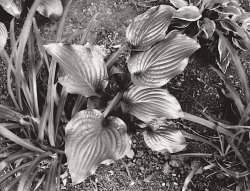
Scan of negative. Taken in open shade with a very even grey afternoon light. It was windy, by the way, hence the leaves blurring. No post scan modifications.20230524-1-001-19-Planted_Evidence.jpg

The extra dilution of D-23 (didn't seem to provide any remarkable increase in sharpness. Likewise, I don't see any particular evidence of edge effects. The leaf textures are nicely enhanced with midtone local constrast expansion as expected, but I get that after an hour already.

While I like what I see, I don't see anything compelling that would justify the extreme extended development.
 
Last edited:
While I like what I see, I don't see anything compelling that would justify the extreme extended development.

I am guessing the SBR would be around 3 if that.
I can clearly see the enhanced mid-tone local contrast expansion in the leaves and the deep shadows appear to have been rendered nicely.

Although you have said that you do not see anything. compelling, what was you expecting when you dropped it in the developer for the extended time over a standard time
 
I had no specific expectations. I wanted to see if overnight development provided any real benefit vs. 1 hr stands. It seems that - other than slightly increased midtone local contrast - there is no real difference.

I have another negative, just processed, of the same scene, but developed for an hour in DK-50 1:3. Results posted when available.
 
I have just been looking at the Steve Sherman video on EMA where he expands a tone quite a way up the scale to around zone 8.
I have seen evidence from my testing od pretty good highlight compression with D23 Semi-Stand when faced with a high SBR but whats your thoughts going the other way with expansion when faced with a low SBR

For scenes with low SBR, I use Pyrocat-HD 1.5:1:200 and agitate with EMA - typically 2-3 times evenly spaced between initial agitation and completion at 60min. This is longer than most EMA recommendations call for, but that, combined with regular intervals of agitation will really pulls the midtone contrast out.

For example, consider this image:

https://www.tundraware.com/Photogra...arge/20210214-1-30-Old_Factory_Experience.jpg

This was shot (on 5x4!) on a flat grey afternoon after a snowstorm. Developed as above. Scan of silver print.

The interior of the shed had no more than a 2 stop SBR, if that. There was diffuse light through the cloud cover coming from the right and above. Unmanipulated, the image would have been grey on grey with a strip of light to the right. EMA popped the midtone contrast nicely and breathed some life into what would otherwise have been a complete visual bore. I did have to burn the right and bottom of the print because of the diffuse overhead light hitting it, but EMA held the detail in the highlights while expanding the midtones.

In general. this is my default practice (all things being equal like film type and grain concerns - for example, I never use D-23 on 35mm negs because the grain becomes apparent relative to Pyrocat-HD):

Low SBR - EMA/60min Pyrocat-HD 1.5:1:200
Normal SBR - Semistand/60min Pyrocat-HD 1.5:1:200
High SBR - Semistand/60min Pyrocat-HD 1.5:1:250 or even 300 OR D-23 1:1 or possibly, 1:3

It seems to not much matter which film I'm using either. I use this general rubric for all films and expose at box speed. The only time it fails is when I meter the wrong thing for Zone III.

I've even used super dilute HC-110 at 1:128 (well beyond Kodak's recommendations) to pull in a 13+ stop SBR. It worked fine but showed more grain than I would have liked with Arista 100 rollfilm. Whether that's the developer or the film or both, I've never bothered to determine. It was more of a curiosity than anything. That combination definitely held both shadows and highlights but - relative to D-23 and Pyrocat - the highlights were considerably more dense, though I was able to print through them using split VC techniques. Likely this is because HC-110 is a pretty active developer.
 
Low SBR - EMA/60min Pyrocat-HD 1.5:1:200
Normal SBR - Semistand/60min Pyrocat-HD 1.5:1:200
High SBR - Semistand/60min Pyrocat-HD 1.5:1:250 or even 300 OR D-23 1:1 or possibly, 1:3

I see you haven't included D23 in the Low SBR here, is this because you haven't tried it or because it never turned out as expected unlike Pyrocat
 
I see you haven't included D23 in the Low SBR here, is this because you haven't tried it or because it never turned out as expected unlike Pyrocat

I don't recall ever trying it. D-23 tends to be lower contrast than Pcat, all things being equal, especially when it is diluted, but that doesn't mean it could be made to work. I am just content with how Pcat handles low SBR and never went further.
 
@Ian-Barber OK, so here is the same image (more or less) shot on the same film and similar lighting conditions, but semistand processed in DK-50 1:3. That developer has historically been a tad grainy for my tastes, but even under high magnification under the enlarger, I didn't see anything objectionable, even though I am diluting beyond recommended.

Scan of 4x5 silver contact print:


20230525-1-014-Planted_Evidence.jpg
 
OK, so here is the same image (more or less) shot on the same film and similar lighting conditions, but semistand processed in DK-50 1:3.

Isn't the DK-50 the replenisher for D23?
The leaves have this silvery tone to them which looks interesting
 
Isn't the DK-50 the replenisher for D23?
The leaves have this silvery tone to them which looks interesting

DK-50 was a Kodak developer that was packaged in 2 parts. DK-50R was the replenisher. It was intended to be used either as stock or 1:1, so using it 1:3 is a bit outside of the originally suggested model. I did this to be able to extend the development time without cranking up the negative contrast too much.

The formula is widely available on the internet. I think Anchell's "Film Development Cookbook" has the formula in it if you want to try it for yourself.

That "silvery tone" is partly the consequence of long, dilute development, and partly due to the paper I used to contact print the negative. Fomabrom 111 VC FB has become one of my beloved papers and I do about 90% of my work on it.

As I do this more and more, I am reaching the conclusion that - once you jump into very long, dilute development - there is a fair bit of latitude for which developer and film to use. They tend to all develop in very similar ways, though, of course, the films exhibit different inherent characteristic curves. As noted previously, you do have to make some adjustment for SBR management and you have to watch grain with smaller formats with most developers other than Pyrocat-HD. But I have no hesitation throwing different emulsions into the developer and letting them all stand around together for an hour...
 
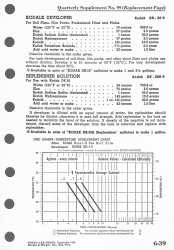
As a followup, I found the formulae for DK-50 and DK-50R in my old 1964 Photolab Index (Note that "Elon" was Kodak's trade name for Metol):
 

Attachments

  • DK-50.jpg
    DK-50.jpg
    150.1 KB · Views: 9
Last edited:
So if you use 100ml stock you then replace it by adding 100ml replenisher to your stock, correct?
 
So if you use 100ml stock you then replace it by adding 100ml replenisher to your stock, correct?

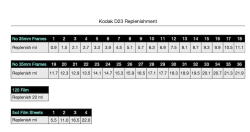
When I was replenishing D23, I made a chart which I used to figure out how much and when to add replenisher

d23-replenish.png
 

Attachments

  • D23 Replenishment.pdf
    58.7 KB · Views: 2
Ian did you add your 22ml (120 film), to your stock then pour your used working developer in to top your stock up to 1ltr?

Basically, yes...
  1. I start with 1L of D23 stock which I mark the bottle at the 1L mark
  2. I pour 500ml of the stock into the Paterson tank and develop the film
  3. Just before the end of the development time, I add 22ml of the replenisher into the 1L bottle
  4. I then pour the contents from the Paterson Tank back into the 1L bottle up to the 1L mark
  5. I then discard any remainder from the Paterson Tank
 
Back
Top