
No. You don't wish the front standard plus lens to accidentally slide off the focussing rail.Me too.
The infinity stops appear to be as far forward as they can go unless I need to remove them completely?

-
Thank You For Visiting... Please Click Here and sign up to contribute and reply to posts and download the resources.
You are using an out of date browser. It may not display this or other websites correctly.
You should upgrade or use an alternative browser.
New toy.
- Thread starter soupdragon
- Start date
This is the best option.I had this problem with a 360mm Nikon on my Rittreck, I could just reach the last bit at infinity, I just made and used a top hat lens board.
- Joined
- Oct 17, 2023
- Messages
- 432
I'm sure we are talking about the same thing I just used the word shim.This is not a lens shim!
This is a relatively broad ring that permits free movement of the aperture mechanism when the lens is attached to the lensboard.
It slips over the rear lens threads, allowing clearance for the aperture mechanism and lives between the lens and lensboard.
So lens, spacer ring, lensboard, retaining ring.
As I recall it was probably about 1mm thick.
Also, the aperture selection mechanism moves in an expected manner as opposed to feeling "pinched" or "restrained.
I will still check this today.
- Joined
- Oct 17, 2023
- Messages
- 432
Good plan.No. You don't wish the front standard plus lens to accidentally slide off the focussing rail.
- Joined
- Oct 17, 2023
- Messages
- 432
Toyo do not make a top hat lens board. Any suggestions ?

- Joined
- Dec 19, 2017
- Messages
- 3,659
The last version of the No. 3 Compur increased the top speed from 1/200 to 1/250. This may have been the result of a new sort of main spring, not sure of that. Also the last version added a shutter speed scale to the front of the shutter. The diaphragm on your shutter should have click stops in steps of 1/3 of a stop.
The No. 3 Compur was more expensive than the No. 3 Copal. Don't know by how much. Ultimately the Copal prevailed in the marketplace. Of course now the Copal line is no longer made either.
David
An issue with leaf shutters is with large aperture lenses is the fastest speeds should be used with the lens stopped down as the shutter itself has an aperture effect at high speeds. As you would rarely use the top speed
The Compur #3 shutter of my 165mm f8 Super Angulon has a top speed of 1/400. This is possible because the elements near the shutter are very much smaller diameter than say a 240mm f5.6 Symmar S so you don't get the aperture effect at 1/400.
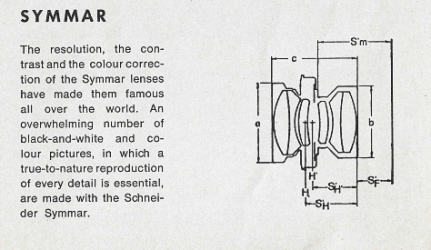
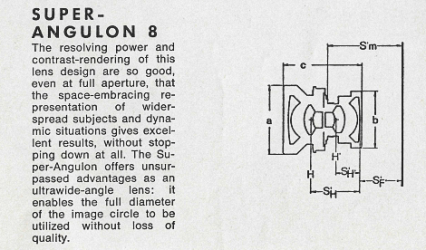
In 1970 Zeiss (the owner of Comur & Prontor) made 4 ranges of shutters, the Compur, CP Electronic, Prontor Press, & PP Electronic.
Ian
- Joined
- Oct 17, 2023
- Messages
- 432
My copy of the lens does not appear to have a spacer.This is not a lens shim!
This is a relatively broad ring that permits free movement of the aperture mechanism when the lens is attached to the lensboard.
It slips over the rear lens threads, allowing clearance for the aperture mechanism and lives between the lens and lensboard.
So lens, spacer ring, lensboard, retaining ring.
All of the functions work as expected with no interference at the interface points (lens board/aperture lever/anything else).
HAVE I BOUGHT A LEMON?
- Joined
- Oct 17, 2023
- Messages
- 432
I can take detailed pictures of the general assembly if it's worth commenting on.
I only have 30 days to return the lens if there is an issue.
soupdragon
What is the dimensions of lens board IE thickness , the hole for the lens. ? I might be able to help.No, definitely not a lemon.My copy of the lens does not appear to have a spacer.
All of the functions work as expected with no interference at the interface points (lens board/aperture lever/anything else).
HAVE I BOUGHT A LEMON?
Here are some threads about spacer rings (and others unfortunately)
https://www.largeformatphotography.info/forum/search.php?searchid=14894211
If it works, it works.


- Joined
- Oct 17, 2023
- Messages
- 432
No, definitely not a lemon.
Here are some threads about spacer rings (and others unfortunately)
https://www.largeformatphotography.info/forum/search.php?searchid=14894211
If it works, it works.
Sorry, the link does not work.No, definitely not a lemon.
Here are some threads about spacer rings (and others unfortunately)
https://www.largeformatphotography.info/forum/search.php?searchid=14894211
If it works, it works.
Thanks anyway.
- Joined
- Oct 17, 2023
- Messages
- 432
This link appears to be dead as well.No, definitely not a lemon.
Here are some threads about spacer rings (and others unfortunately)
https://www.largeformatphotography.info/forum/search.php?searchid=14894211
If it works, it works.
Once again, thanks for trying.
Sorry. It won't let me link the results.
So you'll have to do it manually. Just type 'spacer' into the keyword search bar and change the search to title.
It will throw up a mix of threads some more pertinent than others.
https://www.largeformatphotography.info/forum/search.php
If you need a spacer/shim because the aperture lever is rubbing against the lensboard, or something similar, it’s quite easy to make one yourself. Thin card will suffice. You simply cut a ring with a hole the same size as the lensboard’s hole and the outer diameter any reasonable size that doesn’t cause further obstruction. Most graphic material shops will sell a cutting compass that will make this easier. If one thickness of card is insufficient use two. Black is probably the best colour to reassure you that there are no light leaks.
On a modern lens, this will not affect the optical assembly of the lens. Optical spacing is determined by the machining of the shutter.
The order of assembly, starting from the front would be:
Front lens cell; your new shim/spacer ring; the lensboard itself; the retaining ring, screwed onto the rear of the front lens cell (at this point you will decide the orientation of the lens. Some people like to have it ‘sideways’ to read the scales more easily); finally, after carefully tightening the retaining ring (there’s a special tool for this) add the rear lens cell. Don’t overtighten. Voilà!
There are other shims/spacers that fit between the lens cells and the shutter. These are added by the manufacturer for optical corrections and are beyond the scope of amateur intervention. Not every lens has them. Take care not to lose them if present.
Dismantling a lens is a good opportunity to clean the glass surfaces, but with the greatest care and attention. Google how to do it if there is any doubt at all.