
Install the app
How to install the app on iOS
Follow along with the video below to see how to install our site as a web app on your home screen.

Note: This feature currently requires accessing the site using the built-in Safari browser.
-
Thank You For Visiting... Please Click Here and sign up to contribute and reply to posts and download the resources.
You are using an out of date browser. It may not display this or other websites correctly.
You should upgrade or use an alternative browser.
You should upgrade or use an alternative browser.
Show Us Your Camera
- Thread starter Ian-Barber
- Start date

- Joined
- Aug 22, 2021
- Messages
- 613
Was it for the top screen which is square? The top layer on mine seems like acrylic and I'm not sure if there's a glass screen underneath it. It's plenty bright enough to focus with though.Nice one Nas. I supplied a bespoke scree a few weeks ago, turns out to be for a Gowlandflex,
Ian

- Joined
- Dec 19, 2017
- Messages
- 3,509
It was the square top screen, the camera is slightly different to yours, more like the early 1966 version. U didn't know what camera the screen was for until the buyer posted a couple of images. It looks very bright there may be a fresnel.
Ian
Ian
- Joined
- Aug 21, 2016
- Messages
- 34
I have fairly recently seen another Gowlandflex owner by a collector in Lancashire. He also had to fix the lens calibration. I believe he has disposed of it now because it didn't like using it off a tripod so, for studio work, he preferred his other 5x4 cameras.
- Joined
- Dec 19, 2017
- Messages
- 3,509
The Gowlandflex GG screen I made went to Aberdeen.
There were LF TLR cameras before WWI, Ross sold them in 1/4 plate, 5x4, and 1/2 plate, sizes. They look more compact than the Gowlandflex. The Ross 1910 advert says this is a new model.

Their other reflex cameras are re-badged Kershaw Soho Reflex, so that's a possible manufacturer.
Ian
There were LF TLR cameras before WWI, Ross sold them in 1/4 plate, 5x4, and 1/2 plate, sizes. They look more compact than the Gowlandflex. The Ross 1910 advert says this is a new model.
Their other reflex cameras are re-badged Kershaw Soho Reflex, so that's a possible manufacturer.
Ian
- Joined
- Aug 22, 2021
- Messages
- 613
Very interesting. I've never seen any of these for sale.The Gowlandflex GG screen I made went to Aberdeen.
There were LF TLR cameras before WWI, Ross sold them in 1/4 plate, 5x4, and 1/2 plate, sizes. They look more compact than the Gowlandflex. The Ross 1910 advert says this is a new model.
View attachment 5579
Their other reflex cameras are re-badged Kershaw Soho Reflex, so that's a possible manufacturer.
Ian
- Joined
- Aug 22, 2021
- Messages
- 613
I find using mine on a tripod for portraits is where it shines because you can focus then trip the shutter just as fast as you would with an SLR. With a Grafmatic 6 shot magazine on the back it's a great portrait machine. That's the reason I bought mine. For anything that involves a stationary subject or still life I would use something else. Cheers.I have fairly recently seen another Gowlandflex owner by a collector in Lancashire. He also had to fix the lens calibration. I believe he has disposed of it now because it didn't like using it off a tripod so, for studio work, he preferred his other 5x4 cameras.
I recently bought a couple of lovely vintage cameras in a job lot, along with an unused TP shutter in original box as well as some half plate negatives. The camera shown here is un-named (assume British) so have been trying to find its maker to no joy. It has an unusual round lens board (missing) that i have to make a replacement for but any ideas of a possible maker? its half-plate and with a lovely burgundy bellows in great condition. The base shape does remind me of my Lancaster cameras and the focussing glass is missing. Also no idea what the brass spring is for on the back at the top. Thanks for reading.
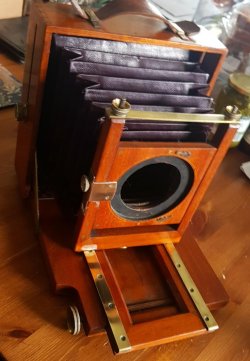

Very nice looking camera camera, Burley cameras could probably make up a lens board for you, they made up one for me for a Szabad camera that didn't come with one. Have you a ground glass focusing screen for it? You might be able to fit a 5x7 back to it so you can use the more easily available film stock available in that format. I'd see if you can get a 5x7 spare film back from Intrepid.

- Joined
- Jun 23, 2022
- Messages
- 291
I have a close relative of this camera. Also without makers mark and with lovely burgundy bellows. Fortunately mine still has its lens board. I use it a fair bit with a modern 4x5 back. Useful because it's lightweight and fits on a modern tripod.I recently bought a couple of lovely vintage cameras in a job lot, along with an unused TP shutter in original box as well as some half plate negatives. The camera shown here is un-named (assume British) so have been trying to find its maker to no joy. It has an unusual round lens board (missing) that i have to make a replacement for but any ideas of a possible maker? its half-plate and with a lovely burgundy bellows in great condition. The base shape does remind me of my Lancaster cameras and the focussing glass is missing. Also no idea what the brass spring is for on the back at the top. Thanks for reading.
View attachment 5599
View attachment 5601
- Joined
- Dec 19, 2017
- Messages
- 3,509
I may have a lens board that fits.

or this pair which are larger,

I moved them a couple of days ago and need to think where I put them. It's a bit chaotic as I was having the house re-roofed.
GG screens are available on eBay, but I don't think any half plate are currently listed. I have at least 2 in stock though and no eBay fees . . . . . . . .
The camera is intriguing, I was given a Lantern slide projector last year, with 2 boxes of slides, by a friend, The projector is quite new, introduced in 1934, but the slides are late 1890s, early 1900,almost no cars and a Royal Mail stage coach. My friend's father was a neighbour, of F.W. Pilditch the photographer, who died in the 1960s in his late 90s. There was a very short-lived Camera manufacturer in Aston.
I'm slowly piecing together Fred Pilditch's history, he e was Secretary of Aston Natural History & Photographic Society, in 1897/8, the Chairman was William Tylar. Your camera has a definite Lancaster look, but also Underwood, so whoever made it may have been using the same supplier for fittings.
Tylar made dark-slides and accessories, also darkroom equipment, and later cameras, I'm not suggesting your camera was made by Tylar, rather that it may well have been made in Birmingham.
Ian
or this pair which are larger,
I moved them a couple of days ago and need to think where I put them. It's a bit chaotic as I was having the house re-roofed.
GG screens are available on eBay, but I don't think any half plate are currently listed. I have at least 2 in stock though
and no eBay fees . . . . . . . . The camera is intriguing, I was given a Lantern slide projector last year, with 2 boxes of slides, by a friend, The projector is quite new, introduced in 1934, but the slides are late 1890s, early 1900,almost no cars and a Royal Mail stage coach. My friend's father was a neighbour, of F.W. Pilditch the photographer, who died in the 1960s in his late 90s. There was a very short-lived Camera manufacturer in Aston.
I'm slowly piecing together Fred Pilditch's history, he e was Secretary of Aston Natural History & Photographic Society, in 1897/8, the Chairman was William Tylar. Your camera has a definite Lancaster look, but also Underwood, so whoever made it may have been using the same supplier for fittings.
Tylar made dark-slides and accessories, also darkroom equipment, and later cameras, I'm not suggesting your camera was made by Tylar, rather that it may well have been made in Birmingham.
Ian
Hi Ian, many thanks for the info. The hole that fits the circular board is 100mm diameter and my attempts to make a new one failed with no circular saw that large in my toolbox and my jigsaw attempt was patheic! If you have one that could fit, I would be very interested, if you are happy to sell one. I am not really too bothered if I cant find the maker, I just hoped for a bit more info for when sell it shortly. Just the GG to sort out. I have a few half-plate exposed glass plates that might fit, havent really tried yet. Appreciate the replies from all forum members so far
- Joined
- Dec 19, 2017
- Messages
- 3,509
I found the circular lens boards too small 80mm, and the other two too large 110mm. I found another circular board, but that's 90mm, I make lens boards quite frequently, and one thought is the wood removed when using a hole cutter, I just checked and my larger set cuts 100mm & 120mm holes (and smaller) but the cut-out piece would be 96mm approx using the 100mm/
Probably something like this is best laser cut these days.
Ian
Probably something like this is best laser cut these days.
Ian
- Joined
- Aug 9, 2016
- Messages
- 852
Or you could do it in a few minutes with a pair of compasses, a coping saw - cut just outside the line - and a file to file down to the line.Probably something like this is best laser cut these days.
Ian


- Joined
- Oct 21, 2020
- Messages
- 464
If anyone wants anything laser cut ... I have a large industrial CO2 laser ...Or you could do it in a few minutes with a pair of compasses, a coping saw - cut just outside the line - and a file to file down to the line.
- Joined
- Aug 22, 2021
- Messages
- 613
This just in. Watson & Sons tail board half-plate. I'm not a massive fan of the tail board design but it's the lens on this which caught my attention. Anyone recognise which camera it's originally from? Apparently, a bit of a rare bird with estimates of only between 300 and 400 ever being made.
This camera came with a 6x8 roll film holder fitted into a wooden frame which works perfectly and markings on the ground glass for 6x8 so clearly it was being used for that format but the odd thing is the furthest you can focus with the bellows fully closed is around 12 inches. Great for close-up shots but not much else. I've just developed the first test roll through it and it's all fine. Bellows are in great condition, the material is quite thick and rigid, possibly not original.
Fortunately it also came with a set of book form half-plate holders which all have film sheaths inside. This was an unexpected but very welcome surprise. Now I just need to decide which lens to put on this to cover Half-plate. I can cut down x-ray film to use with this or some of my Aerographic Plus-X which is on a 5 inch wide roll.

This camera came with a 6x8 roll film holder fitted into a wooden frame which works perfectly and markings on the ground glass for 6x8 so clearly it was being used for that format but the odd thing is the furthest you can focus with the bellows fully closed is around 12 inches. Great for close-up shots but not much else. I've just developed the first test roll through it and it's all fine. Bellows are in great condition, the material is quite thick and rigid, possibly not original.
Fortunately it also came with a set of book form half-plate holders which all have film sheaths inside. This was an unexpected but very welcome surprise. Now I just need to decide which lens to put on this to cover Half-plate. I can cut down x-ray film to use with this or some of my Aerographic Plus-X which is on a 5 inch wide roll.
- Joined
- Dec 19, 2017
- Messages
- 3,509
The lens was sold with a Kershaw Peregrine III camera, a coupled rangefinder MF 6x6 camera. Only around 1265 of the cameras were made, approx 1948-53. The shutter is also made by Kershaw.
Kershaw were bought by Rank in 1947, T,T&H were also owned by Rank at the time.
Ian
Kershaw were bought by Rank in 1947, T,T&H were also owned by Rank at the time.
Ian
- Joined
- Aug 22, 2021
- Messages
- 613
That's correct about the lens being sold with the Peregrine III, that was my first thought when I saw the listing. Where are you getting your production dates and quantity info from? Camerawiki says around two years from 1948: https://camera-wiki.org/wiki/Kershaw_PeregrineThe lens was sold with a Kershaw Peregrine III camera, a coupled rangefinder MF 6x6 camera. Only around 1265 of the cameras were made, approx 1948-53. The shutter is also made by Kershaw.
Kershaw were bought by Rank in 1947, T,T&H were also owned by Rank at the time.
Ian
Various different opinions online about the production numbers average to between 300 and 400. No one seems to be pointing to any official source of information so take it with a pinch of salt. I don't mind, I just think this is an interesting choice of lens to attach to this half-plate camera
. Looks like the closest distance the Peregrine III can focus is 4.5 feet. Maybe that was too limiting for the previous owner.
Last edited:
- Joined
- Dec 19, 2017
- Messages
- 3,509
Well Rank stopped camera production by Kershaw in 1953, concentrating on cine equipment. No photographic companies owned by Rank did well under their ownership, due to lack of investment. Rank went through many financial crises.
I think the 1650 figure is the total number of Peregrine II & III cameras sold, about a quarter being the III. In1948 to early 1950s there was only really one UK competitor, the better known Ensign cameras with Epsilon shutters and Ross lenses. Imports needed an Import licence, as we had severe import restrictions after WWII, so. These were partially lifted in 1950 and eased by about 1952.
The 1948 Advert for the Peregine III lists the camera as £64 10s 2d inc Purchase tax, this was dropped a year later to £58 1s 0d and this includes £17 11s 0d Purchase tax, which was 42% for cameras at the time.
In comparison, an Ensign Auto-Range camera was £27 19s 0d including Purchase tax, so the Peregrine III was way too expensive to compete.
Ian
I think the 1650 figure is the total number of Peregrine II & III cameras sold, about a quarter being the III. In1948 to early 1950s there was only really one UK competitor, the better known Ensign cameras with Epsilon shutters and Ross lenses. Imports needed an Import licence, as we had severe import restrictions after WWII, so. These were partially lifted in 1950 and eased by about 1952.
The 1948 Advert for the Peregine III lists the camera as £64 10s 2d inc Purchase tax, this was dropped a year later to £58 1s 0d and this includes £17 11s 0d Purchase tax, which was 42% for cameras at the time.
In comparison, an Ensign Auto-Range camera was £27 19s 0d including Purchase tax, so the Peregrine III was way too expensive to compete.
Ian