Happy Days

All lenses will focus as close as the bellows extension allows. With LF, that’s the deciding factor. There may be some image deterioration and it’s a matter of individual judgement what is acceptable in each case. There are, of course specialist lenses but they tend to be rare and expensive.
For very close work, a high-end digital camera and focus stacking has probably usurped this field.

I meant just for the test David, sorry.
 
The one with circles is the fresnel lens. I fitted a fresnel onto one of my Speed Graphic’s and after testing it had to be fitted on top of the ground glass (closest to me) to achieve accurate focus. This is not common and that’s why focus testing is essential.

I had to fit a fresnel that way on my Crown Graphic, I service a Speed Graphic for a member here a few years ago, and fitted new bllows, I was asked if I could see why images weren't sharp at wider apertures, the previous owner had added a fresnel under the GG screen.

It helps having spare Pacemaker Graflok GG frames, I just swapped and saw the difference.

Wnen testing focus against a tape/ruler you shoot wide open.

Ian
 
I meant just for the test David, sorry.
Don’t worry about a specific distance from the tape measure, focus so that you can see the individual markings either side of your chosen point of focus. Ultimately you’ll need to read the markings when you analyse the neg. Does that make sense? The tape must be going away from the camera. Angle it up at 30 degrees or so.
As Ian said, shoot the test with the lens aperture fully open.
 
You can get a digital depth gauge for around twenty pounds. Not a tyre depth gauge but an engineering tool.
The distance from the front face of your dark slide to the film surface should be equal to the distance from the surface on the camera where the dark slide sits to the ground surface of the focus screen. In practice it suffices to measure to the back of the dark slide as the film thickness is too small to make much difference. Glass plates might be different of course.
 
You can get a digital depth gauge for around twenty pounds. Not a tyre depth gauge but an engineering tool.
The distance from the front face of your dark slide to the film surface should be equal to the distance from the surface on the camera where the dark slide sits to the ground surface of the focus screen. In practice it suffices to measure to the back of the dark slide as the film thickness is too small to make much difference. Glass plates might be different of course.
I have Verniers David, thanks for that tip.
 
Right oh, I have some measurements

Fidelity Elite film holder - depth slot to film holder 5mm, could knock off 0.25mm for film thickness i suppose
Graflex back - face where back seats to receiver where glass sits 3.5mm
Ground glass - 1.5 mm
Fresnel - 2 mm

As assembled ground glass was sat on the fresnel giving at best 5.5 mm at worst 7mm depend on which way ground side faces.

By my calculations best distance I can get is 3.5mm with ground side seated first towards lens 5mm with ground glass facing me
Perfection would be 1mm shims and ground side of glass facing lens.

How accurate do we need to be ?
 
Personally I would aim for spot on with shims then do some tests with the tape measure as described above. No sense in having it sort of close unless you're happy to live with that once in a blue moon shot potentially being soft. As the saying goes "there's sharp and there's sharp enough". It's your call.
 
Sums wrong there, dont need shims, depth 3.5mm plus glass reversed to have ground side facing me is 5mm.
Potentially the thickness of the film out.
I put the grooves in the fresnel facing me not butted up to ground side is that right?
 
Sums wrong there, dont need shims, depth 3.5mm plus glass reversed to have ground side facing me is 5mm.
Potentially the thickness of the film out.
I put the grooves in the fresnel facing me not butted up to ground side is that right?
I think the fresnel grooves should usually face towards the lens but from memory I have one which had to face towards me to give the sharpest result. Can't remember which camera that is.
 
I think the fresnel grooves should usually face towards the lens but from memory I have one which had to face towards me to give the sharpest result. Can't remember which camera that is.
I have just thought NAS that there is the potetial to damage the grooves of the fresnel if that side faces me. that cant be right.
 
It's a bit obvious really when you think about it, the curved effect of the fresnel needs to bring in and focus light from the lens side not from behind you.

set up and ready to take the shot, do not need the lens hood or darkcloth its pretty clear.
 
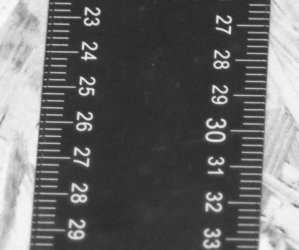
Test shots-5.JPG
100% Crop

Focus on the thirty
Foma 100 Ei 400 in 510 pyro
F 4.7 1/2 second
I nearly slipped up and took the shot at f8 where there was notably more definition, distance approx 2'6"
 
I have just thought NAS that there is the potetial to damage the grooves of the fresnel if that side faces me. that cant be right.
I agree, I don’t think it’s right but that’s how I had to have mine to get the focus calibrated. in my tests.
 
View attachment 6487
100% Crop

Focus on the thirty
Foma 100 Ei 400 in 510 pyro
F 4.7 1/2 second
I nearly slipped up and took the shot at f8 where there was notably more definition, distance approx 2'6"
It’s hard to tell but it’s not a million miles away. Try a test outdoors now with a sturdy tripod and cable release.
 
It’s hard to tell but it’s not a million miles away. Try a test outdoors now with a sturdy tripod and cable release.
That was moving forward into the focus zone, going to try moving backwards into it as well, I'm happy with the developing there.
I dont know how a 70 year old lens is supposed to look wide open at 100% crop.
My initial thought was that it would be lovely for a portrait.
 
That was moving forward into the focus zone, going to try moving backwards into it as well, I'm happy with the developing there.
I dont know how a 70 year old lens is supposed to look wide open at 100% crop.
My initial thought was that it would be lovely for a portrait.
I think you should photograph the tape at a more acute angle so that it's clearer which direction the focus spot is hitting compared to where you focussed. Sometimes I use a cereal box with lots of text on the back and angle it away from the camera quite steeply. Can you visualise that? Make a note on exactly where you focussed and you should be able to see if the focus on the neg is in front or behind that spot.
 
Right oh, I have some measurements

Fidelity Elite film holder - depth slot to film holder 5mm, could knock off 0.25mm for film thickness i suppose
Graflex back - face where back seats to receiver where glass sits 3.5mm
Ground glass - 1.5 mm
Fresnel - 2 mm

As assembled ground glass was sat on the fresnel giving at best 5.5 mm at worst 7mm depend on which way ground side faces.

By my calculations best distance I can get is 3.5mm with ground side seated first towards lens 5mm with ground glass facing me
Perfection would be 1mm shims and ground side of glass facing lens.

How accurate do we need to be ?

That;s as it should be, matches my 2 Pacemaker Graflok frames with fresnels.

Without a fresnel the T distance for is 2x3 to 4x5 film is: 5.0 mm (0.197 inches) ± 0.178 mm (0.007") This is the modern ISO standard. the older ANSI/BS standard was 0.200".

Early MPP holders were made to the 0.2" standard, some say they are useless, however they do fall within that +/-0.007 tolerance, in practice they are fine.

A fresnel is a lens so that shifts the ground glass side back slightly fom the 5mm T distance.

Ian
 
Last edited:
Fresnel lenses are made of plastic and very easily scratched. These scratches are cumulative and one day, they’ll annoying you and you’ll have to pay for a new one.
It makes no difference which way it faces, so you might as well have the fragile grooves and ridges protected.
in any case, it takes no part in focusing the image other than making it easier to view. It’s not in the light-path when you make the exposure.
 
Fresnel lenses are made of plastic and very easily scratched. These scratches are cumulative and one day, they’ll annoying you and you’ll have to pay for a new one.
It makes no difference which way it faces, so you might as well have the fragile grooves and ridges protected.
in any case, it takes no part in focusing the image other than making it easier to view. It’s not in the light-path when you make the exposure.
Thanks David

No one has yet said if that resolution is acceptable for that lens, what do you think guys ?
 
Fresnel lenses are made of plastic and very easily scratched. These scratches are cumulative and one day, they’ll annoying you and you’ll have to pay for a new one.
It makes no difference which way it faces, so you might as well have the fragile grooves and ridges protected.
in any case, it takes no part in focusing the image other than making it easier to view. It’s not in the light-path when you make the exposure.

The fresnel on my Wista is at least 40 years old and still like new, despite the camera having heavy wear and tear.

You can't put a new fresnel in place of the originals on Pacemaker Graphics because there's a very significant thickness difference, modern fresnels are a bit less than half the thickness.

My Pacemaker & Super Graphic fresnels are all in good condition as well, and they are at least 50 years old.

Ian
 
Back
Top